
By Hugh T. Ferguson, NASFAA Managing Editor
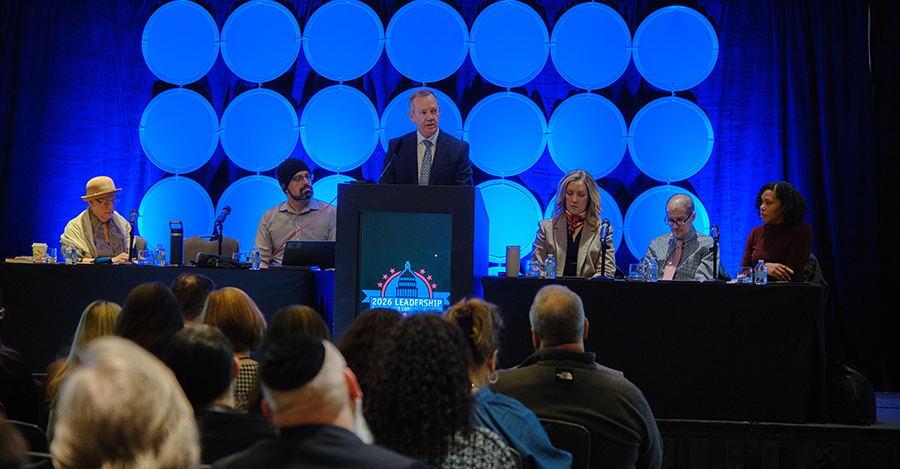
During the second day of NASFAA's annual Leadership & Legislative Conference & Expo, Department of Education (ED) officials provided attendees with the latest regulatory guidance on the One Big Beautiful Bill Act (OBBBA) and dove into new FAFSA features, training opportunities, updates to the student loan programs, verification, and more.
Richard Lucas, acting chief operating officer of Federal Student Aid (FSA), kicked off Tuesday’s session by recounting his experience as a first-generation college student.
“Education opened the door I didn’t know how to open myself,” Lucas said. “What has stayed with me for nearly 40 years in public service is simple: talent is everywhere, opportunity is not, and when opportunity depends on the programs we administer, failure is not an option.”
He went on to highlight the important work that financial aid administrators do in their offices and how they serve students, families, and taxpayers.
“As NASFAA members, you live this reality every day. You are not abstract administrators. You are trusted guides through one of the most important and perhaps most confusing processes in a student’s life,” he said.
Lucas outlined the administration’s priorities and its efforts to transform student aid programs with the department’s implementation of a new income-driven repayment plan, new loan limits on graduate and professional programs, and the modernization of technology systems like Partner Connect and cybersecurity to combat fraud.
He also noted that ED was working to strengthen the financial health of the federal student loan system, which is now nearing $1.7 trillion in outstanding balances.
“Today, less than 40% of all borrowers are in repayment, which is a national crisis that we must address immediately,” Lucal said. “We are committed to working with institutions of higher education to improve loan repayment outcomes, which is where our partnership comes into play.”
Lucas also urged schools to conduct “productive and sustained outreach” to former students who are delinquent or in default on their federal student loans, stressing that schools need to monitor their cohort default rates (CDR) or risk losing access to federal student assistance.
Next month's FSA training conference will highlight default prevention, among several topics that are still in the works, per Lucas’s remarks. Lucas encouraged LLCE participants to attend the FSA conference and stressed the importance of the department’s partnership with the financial aid community. He also recognized that when ED experiences operational struggles, they are immediately felt by the aid community.
”So let me say this clearly: anything that disrupts students' access to aid is unacceptable. That is why operational excellence at FSA is not an internal management goal,” Lucas said. “It is a shared obligation to the higher education ecosystem.”
Aaron Lemon-Strauss, FAFSA program executive director, then turned to updates and trends with the FAFSA form, which recently eclipsed 8 million submissions for the 2026-27 application. He also noted that, following the rollout of FAFSA simplification, hold times for call centers have consistently been under a minute, but recognized the difficulties associated with FAFSA simplification efforts.
“The FAFSA Simplification Act, the FUTURE Act, was a tremendous accomplishment in public policy making — bipartisan, bicameral, looking at a problem and passing legislation to solve it,” Lemon-Strauss said. “We went through, you know, some rough patches on the implementation, but the core legislation and the policy and the ideas behind it [were] so good, and once we could get the implementation right, we're now seeing the results.”
That includes 1.7 million more students becoming eligible for the maximum Pell Grant, a number that Lemon-Strauss expects to increase in subsequent cycles.
In terms of additional system updates, Lemon-Strauss highlighted the inclusion of timestamps on ISIRs to ensure that it’s clear when students meet specific FAFSA filing deadlines for state aid programs. Lemon-Strauss also indicated that ED is working to develop real-time ISIR processing, as he encouraged attendees to tune in to the FSA training conference next month. Topics and an agenda for that conference are still in the works.
He also indicated that in upcoming months, the department was confident it could raise the threshold for verification flags starting in the spring of 2026, which should result in less work for schools during the verification process.
“The goal of the FAFSA is to increase access to student aid; the goal of the FAFSA isn’t to block fraud,” Lemon-Strauss added. In an effort to shift the burden of ID validation away from aid offices, he explained that ED would work to have prospective students verify their identity when flagged as possibly fraudulent by having them come on camera and show identification, though he noted that details are still being discussed.
Eric Hardy, program manager for strategic planning and policy implementation, provided brief updates on loan repayment, focusing on how OBBBA has impacted repayment options.
Due to the ongoing negotiated rulemaking process and open public comment period, ED was limited in what it could discuss. Hardy urged attendees to submit feedback while the comment period remained open.
Kerri Moseley-Hobbs, director for the student aid policy branch, then provided an overview of the Workforce Pell program (WFP) and how ED is working with the Department of Labor (DOL) on implementation. She also reiterated that WFP is not a new grant program, but instead an expansion of the Pell Grant, and that the department would continue efforts to clearly define the parameters of the aid.
Linnea Hengst, program specialist for policy implementation and oversight, then provided updates related to verification guidance mentioned and ED resources available to financial aid professionals.
Publication Date: 2/11/2026
Nedi G | 2/11/2026 7:57:26 PM
Hugh, with all due respect, this reads like a fluff piece written by Fox News. Well done.
You must be logged in to comment on this page.