



Meet NASFAA’s 2026 Dallas Martin Endowment Policy Intern: Sophie Gamble
By Sophie Gamble, NASFAA Policy Staff
Hello NASFAA Community,
I’m thrilled to be working as the 2026 Dallas Martin Endowment Policy Intern this summer. I’m based in Philadelphia as I complete my master’s program in Education Policy, though I originally come from small-town Ohio and remain quite connected to my midwestern identity. I’m passionate about college access and success, including the ways in which financial literacy and Federal Student Aid policy shape students’ ability to enroll in and complete higher education. I am excited to continue exploring policy at a time when so much is changing in higher education and student aid, and I look forward to learning from this community’s expertise and experience.
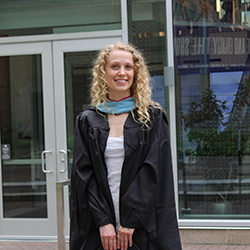 Student loans, along with Hamilton College’s need-blind admissions policy and commitment to meeting full demonstrated financial need made it possible for me to attend college. That experience sparked my curiosity about how these systems operate in practice, leading me to work in the office of admission at Hamilton for four years. During this time, I worked as a peer mentor for first-generation and international students and with On Point For College, an access-focused non-profit in upstate New York that taught me a lot about grants and fundraising. It was through this combination of experiences that I saw the importance of both the administrative and student-support sides of college access, as well as the need to ensure policy implementation meaningfully reaches the students it is intended to serve.
I am most interested in how policy is lived, which comes from my background in the social sciences. I believe that, to be most effective, higher education policy must take into account the lived experiences of students, families, administrators, and institutional staff who are directly impacted by – and responsible for implementing – these policies. As an undergraduate, I majored in anthropology with minors in government and French, while also studying economics and education through my institution’s interdisciplinary curriculum. My research ranged from examining the history of postcolonial French education to using quantitative analysis to better understand political affiliation and attitudes toward educational spending. I also conducted a three-year ethnographic thesis project focusing on how diversity has been marketed and institutionalized on college campuses.
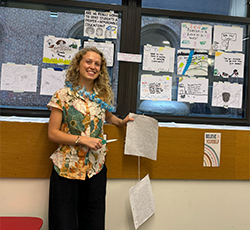 In 2024, I worked in New York City with Breakthrough Collaborative as a writing teacher. I learned as much from my students as they learned from me – about their aspirations, the history of their city, and how critical it is for students to have adults who believe in them and invest in their potential (see the attached photo of one of my students’ final projects about providing proper and affordable higher education for all!).
Investing in students’ potential also requires ensuring that students have the tools and information needed to navigate complex admissions and financial aid systems: knowing where to apply, how to access resources, and how to advocate for oneself within unfamiliar institutions. I see reducing financial barriers to access as both an equity issue and a public investment in shared prosperity, given the countless knock-on benefits higher education provides. Continuing this work, in 2025 I joined Teach For America’s Ignite Fellowship and participated in a public speaking competition where I argued for expanded access to higher education for incarcerated individuals, drawing on the same belief that education serves a broader public good.
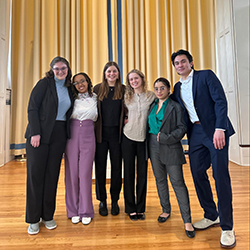 Throughout my time at University of Pennsylvania Graduate School of Education, I worked as a Graduate Assistant in the Office of Admissions and Financial Aid, which expanded my understanding of admissions and financial aid at the graduate and professional level. In my coursework, I applied cost-benefit and cost-effectiveness methods of economic evaluation, studied K-12 public school funding formulas, and researched the ways in which test-optional policies influence undermatching in the admissions process. Beyond the classroom, I sought opportunities to make college access information more accessible: I spoke on the Barrier Breakers™ podcast to guide French-speaking families through financial aid basics in the hope of expanding multilingual financial aid resources, and I will soon begin volunteering with ScholarMatch to support students through the college application process.
In my free time, I love spending time outdoors – playing rugby, hiking, or looking for four-leaf clovers – practicing the piano, and working on creative writing projects.
I am in the third week of my NASFAA internship, where I have already learned a lot in a very short period of time. My goal for this summer is just that – to learn as much as I can! I’m excited to be attending the National Conference later this month in National Harbor, and the Postsecondary National Policy Institute’s Boot Camp in July. In my second week, I had the opportunity to attend the EASFAA conference here in Philly, where I met new colleagues and heard about the strategies and challenges members are navigating. I also participated in our Advocacy Pipeline, where I was able to hear some of you speak with your representatives and advocate so thoughtfully for the students you serve.
I’m grateful to be joining a community that cares so deeply about research, policy analysis, and advocacy in service of students and financial aid administration across the country. I would be thrilled to connect with any and all of you at the conference or over email. Thanks so much for reading, and for all of the warm welcomes!
Publication Date: 6/3/2026

You must be logged in to comment on this page.