



Understanding Cohort Default Rates
 FY 2023 CDR
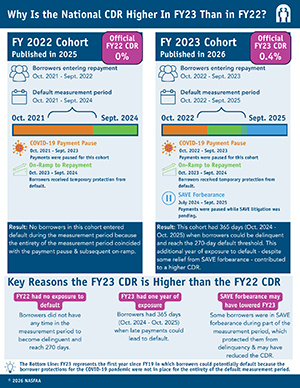
The fiscal year (FY) 2023 federal student loan national cohort default rate (CDR), rose from the FY 2022 rate, from 0% to 0.4%. Set at zero for the past three years due to the Covid-19 payment pause (March 20, 2020 through September 1, 2023) and subsequent on-ramp to repayment (when borrowers were protected from the consequences of delinquency, including default, between October 1, 2023 and September 30, 2024), the FY 2023 CDR was the first since FY 2019 that included a default measurement period during which federal student loan borrowers could have potentially entered default status.
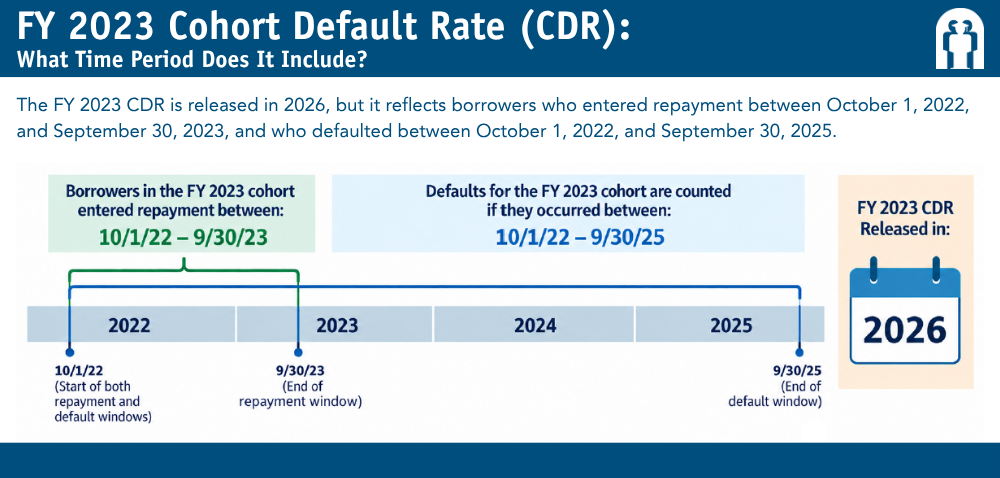
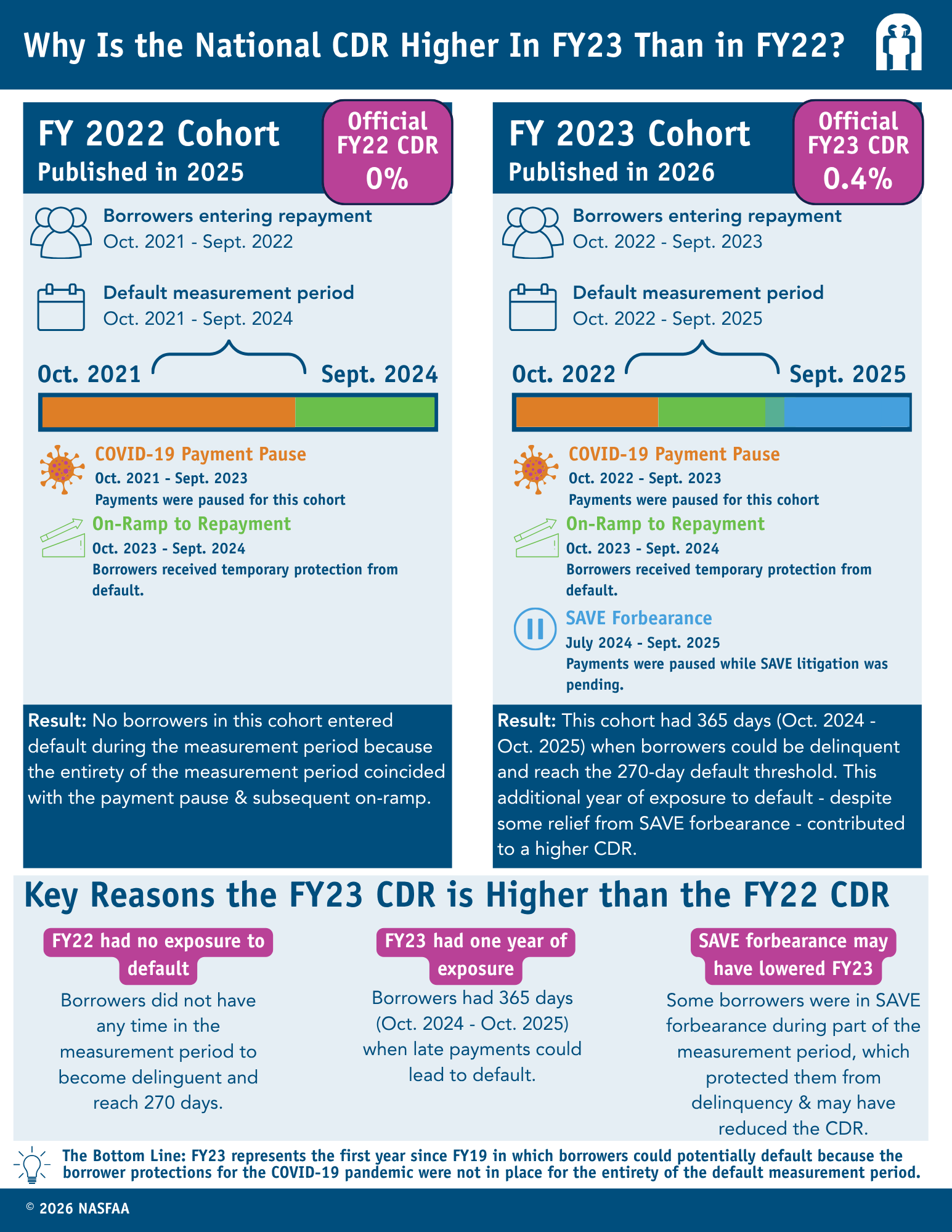
The CDR measures student loan defaults for the cohort of borrowers who entered repayment in the fiscal year that began four years prior and who defaulted in any of the three fiscal years that followed. So, the FY 2023 CDR, released on September 30, 2026, included borrowers who entered repayment between October 1, 2022, and September 30, 2023, and who defaulted on their loans between October 1, 2022, and September 30, 2025.
The CDR is a snapshot of the repayment activity of a subset of borrowers who recently entered repayment. It does not represent the percentage of federal student loan borrowers overall who are in default status (the cumulative default rate), because borrowers can default at any time during their repayment period.
“Typical” CDRs Versus Pandemic-Era CDRs
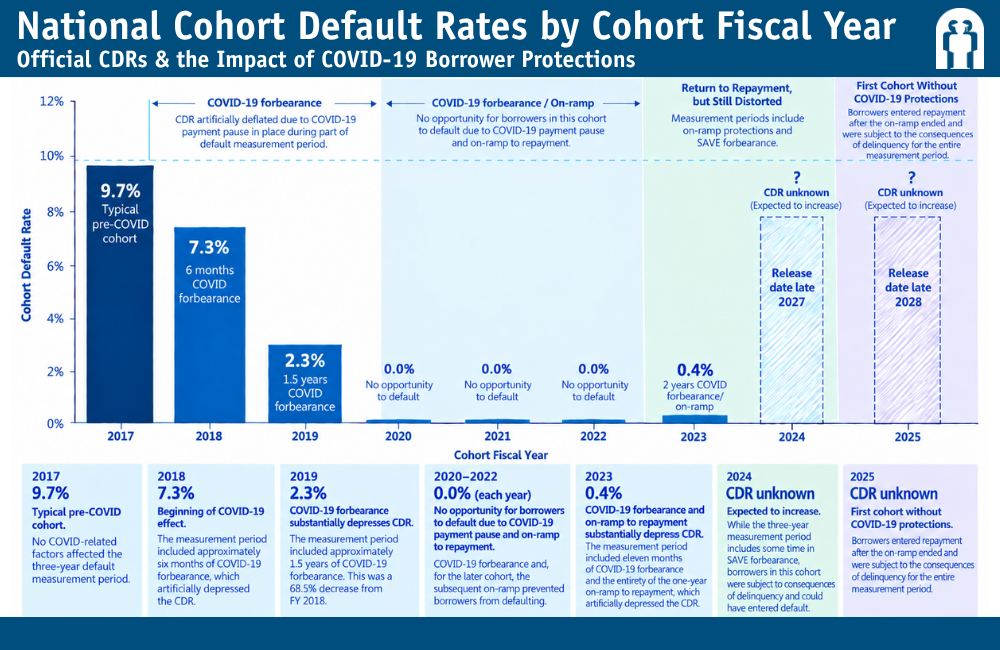
The 9.7% national CDR for FY 2017 represented the last time prior to FY 2023 that the CDR included a cohort of borrowers whose three-year default measurement period did not include any Covid-19-related payment relief.
Beginning with the FY 2018 cohort and continuing through the FY 2022 cohort, borrower protections related to the Covid-19 pandemic insulated borrowers from defaulting for some or all of the three-year default measurement period. This presumably artificially lowered the CDR in FY 2018 and 2019 (assuming a shorter window in which to default results in fewer defaults), and ultimately set the CDR at zero for FYs 2020-2022 when it was not possible for borrowers to default.
The FY 2023 national CDR was a non-zero number for the first time since FY 2019 because the on-ramp to repayment ended on September 30, 2024, while the default measurement period includes borrowers who defaulted on their loans through September 30, 2025. Because borrowers had a 365-day period during which they could have missed payments for 270 consecutive days (the point at which a delinquent loan becomes a default), there was an opportunity for borrowers in this cohort to default. However, as with FY 2018 and 2019, the shorter-than-typical three-year default window is likely the reason the FY 2023 CDR was so low. Another contributing factor to a lower-than-typical CDR for FY 2023 is the Saving for a Valuable Education (SAVE) repayment plan forbearance, which began in July, 2024 and was still in place at the end of the default measure period for this cohort.
Future CDRs
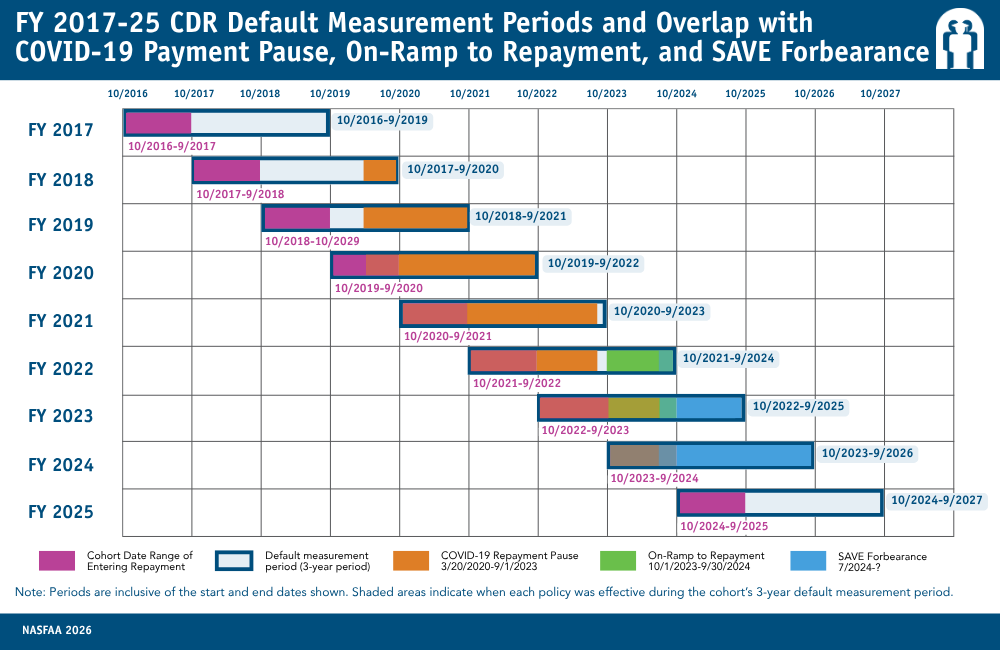
This pattern of a lower-than-typical CDR will likely continue for the FY 2024 CDR, although that year’s cohort will have a longer window to default, so it is reasonable to expect the FY 2024 CDR to be higher than FY 2023’s.
The FY 2024 cohort is also impacted by the SAVE repayment plan forbearance, which began in July, 2024 and will have been in place through the end of the default measurement period for those cohorts, although some SAVE borrowers will have transitioned out of SAVE during the default measurement period due to the SAVE plan ending through litigation during the final year of this cohort’s default window.
What is unknown at this point is how the extended time that borrowers were protected from default during the payment pause and on-ramp to repayment influenced their repayment behaviors once payments were required and the consequences of delinquency were reinstated. Even with the short window to default for FY 2024, it is possible that borrowers, unaccustomed to making payments for an extended period of time, default at higher rates than during the pre-pandemic era.
The Department of Education (ED) releases data on borrower nonpayment rates, which could provide some insight into future default rates. Importantly, though, nonpayment rates are not default rates. Nonpayment rates are the percentage of Direct Loan borrowers who entered repayment since January 2020 and whose federal student loans were more than 90 days delinquent at the time the data were collected.
The FY 2025 CDR, which will be released in 2028, will be the first CDR since FY 2017 for which the full three-year default measurement window had no special protections for borrowers, because this cohort will include borrowers who entered repayment between October 1, 2024 and September 30, 2025 and who default on their loans between October 1, 2024 and September 30, 2027. This cohort entered repayment after the Covid-19 payment pause and the on-ramp to repayment ended. They also entered repayment after new enrollments to the SAVE plan ceased, so would not have experienced any time in the SAVE forbearance.
CDR Implications for Institutions
Institutions with a CDR of 30% or higher for any year are required to submit a default prevention plan to ED, and a CDR of 40% or higher in any single year leads to immediate loss of eligibility to participate in the Direct Loan program. This means that some institutions may be subject this year to the implications of a high CDR for the first time since 2022, the last year with a non-zero CDR (for fiscal year 2019).
For two consecutive years with a CDR of 30% or more, institutions must submit a revised default prevention plan and may be subject to provisional certification. After three consecutive years with a CDR of 30% or more, institutions lose eligibility to participate in the Federal Pell Grant and Direct Loan programs.
Institutions with CDRs below 15% for the three most recent fiscal years are exempt from the requirement to delay first-year undergraduate disbursements until 30 days after the first day of the student’s program of study. They are also exempt from the requirement to disburse single-term loans in multiple disbursements.
Generative AI tools supported the creation of images on this page. All AI-assisted work was reviewed and edited by NASFAA’s Policy & Federal Relations and Communications teams.