



AHEAD Committee Kicks Off Second Neg Reg Session Focused on New Accountability Framework
By Maria Carrasco, NASFAA Staff Reporter , Megan Walter, Senior Policy Analyst
The Accountability in Higher Education and Access through Demand-driven Workforce Pell (AHEAD) Committee began its second session of negotiated rulemaking on Monday, focusing on the new accountability framework enacted under the One Big Beautiful Bill Act (OBBBA). The AHEAD Committee first met in December to discuss the creation of a new Workforce Pell Grant program.
In opening remarks on Monday, both the Department of Education’s (ED) Jeffrey Andrade, assistant secretary for policy, planning, and innovation for the Office of Postsecondary Education, and Dave Musser, ED’s federal negotiator, spoke on the goal of this second session – “harmonization” between the existing Gainful Employment (GE) framework with the new accountability framework enacted by the OBBBA.
To achieve “harmonization,” ED emphasized that its framework should apply to all institutional sectors and program types, noting that negotiators should keep this in mind when creating proposals.
“Alignment and harmonization is a very important facet of the department's design of these regulations,” Musser said. “Although we will certainly entertain ideas or proposals that would treat certain types of programs or sectors differently from one another, with respect to these metrics, it will be more challenging for the department to accept those proposals given this intent. Our strong intent is to maintain alignment across all Title IV eligible programs with respect to how the metric applies to them.”
Before diving into how the new accountability framework would be designed, ED centered on new reporting requirements related to program eligibility. Musser explained that all institutions will now be required to report all new programs (GE and non-GE) to ED via Partner Connect within 10 days of offering them, a shift from the current rules that only require this reporting for new GE programs.
While Musser noted that institutions that are currently allowed to self-certify eligibility will still be able to do so, negotiators Aaron Lacey, representing private nonprofit institutions of higher education, and Jeff Arthur, representing proprietary institutions of higher education, expressed concern over ED’s administrative capacity to handle this influx of data, especially with the department’s recent staffing reductions. Arthur specifically highlighted the existing long wait times for program approvals — often exceeding a year for proprietary institutions — and questioned how the agency would manage the increased workload. Musser responded that ED is working to improve Partner Connect and clarified that while reporting is mandatory for all, this does not change which programs and institutions are required to get approval from ED before being Title IV eligible.
The committee then turned to the new framework, which the Department described as an effort to reduce burden for both ED and institutions by amending the existing GE/FVT regulations to align with the accountability framework required by the OBBBA. Essentially, the current GE and Financial Value Transparency (FVT) structure is replaced with two new frameworks: a transparency framework called the Student Tuition and Transparency System (STATS) and an accountability framework referred to as earnings accountability. However, some of the existing components created under GE/FVT regulations would remain.
The transparency framework, STATS, addresses the earnings premium calculation and associated reporting, whereas the proposed earnings accountability regulations address program eligibility consequences and student warnings.
While the proposed text includes many changes compared to existing regulations, including how cohorts are determined and which programs are exempt, some of the most notable changes include:
-
The GE/FVT debt-to-earnings test would be eliminated.
-
Programs are at risk of losing only Direct Loan eligibility under the new framework. Failing metrics would not impact Title IV eligibility overall.
-
Both STATS and the new earnings accountability provision [described later in this article] apply to all GE and non-GE programs.
The chart below shows the modifications to the existing GE framework, in which ED has proposed eliminating the Debt-to-Earnings test.
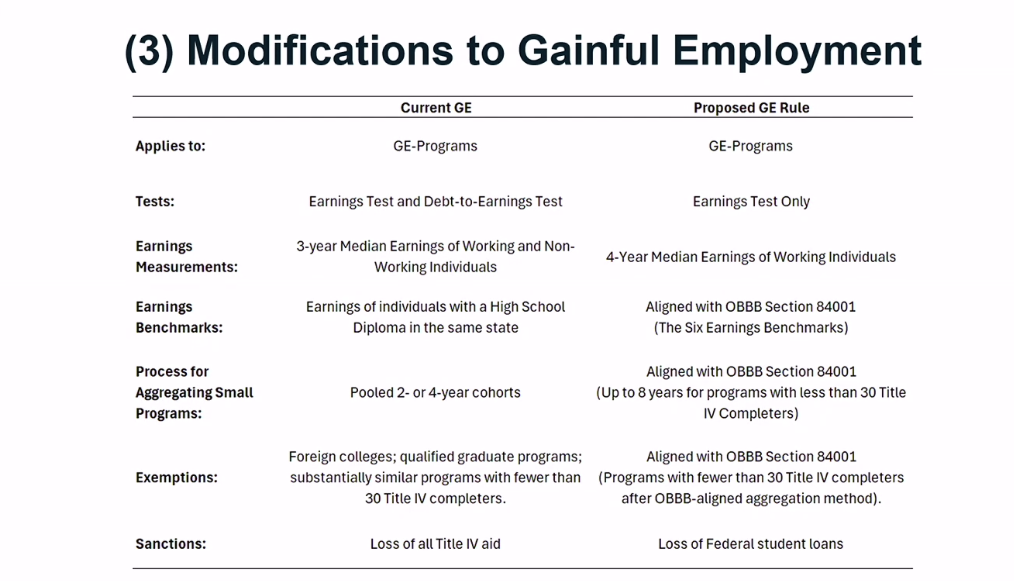
Earning measurements would be based on the four-year median earnings of working individuals, as opposed to the three-year median earnings of both working and non-working individuals, which are currently used as the basis for these measurements. The earning benchmark would use one of the six earnings benchmarks created by ED.
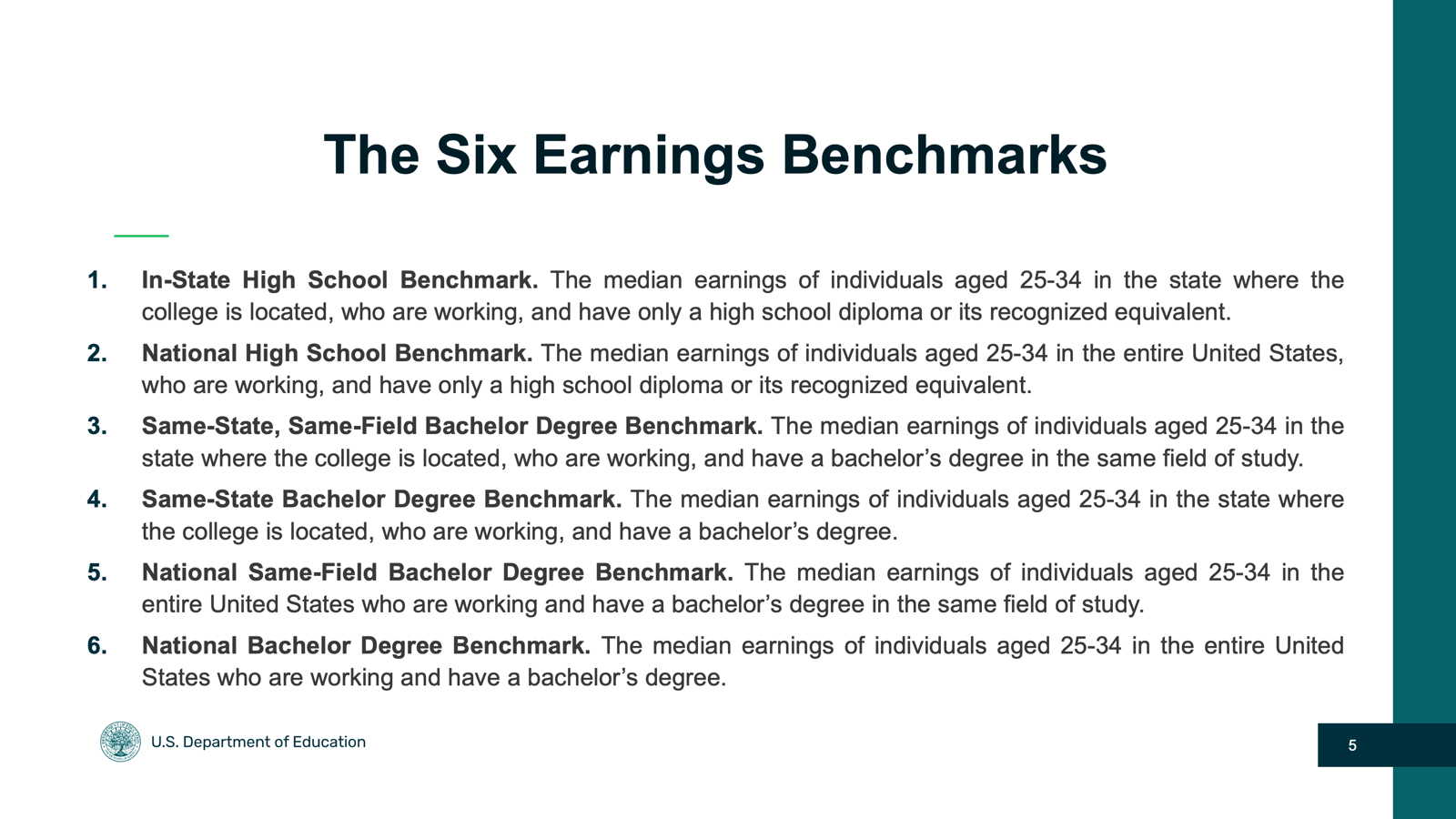
Failing the designated earning premium metric for two out of any three consecutive award years would result in the loss of the program’s Federal Direct Loan eligibility.
While the same metrics are used to evaluate all programs, there are two pathways for which ED created the flowcharts below to help institutions understand which of the six benchmark data pools their program would be measured against, depending on program type. Two pathways were needed because non-degree undergraduate programs were not included in the new accountability framework in OBBBA; however, these programs would still be subject to STATS and the earnings accountability based on the changes made to the regulatory text.
ED created the flowcharts below to help institutions understand which of the six benchmark data pools their program would be measured against, depending on program type.
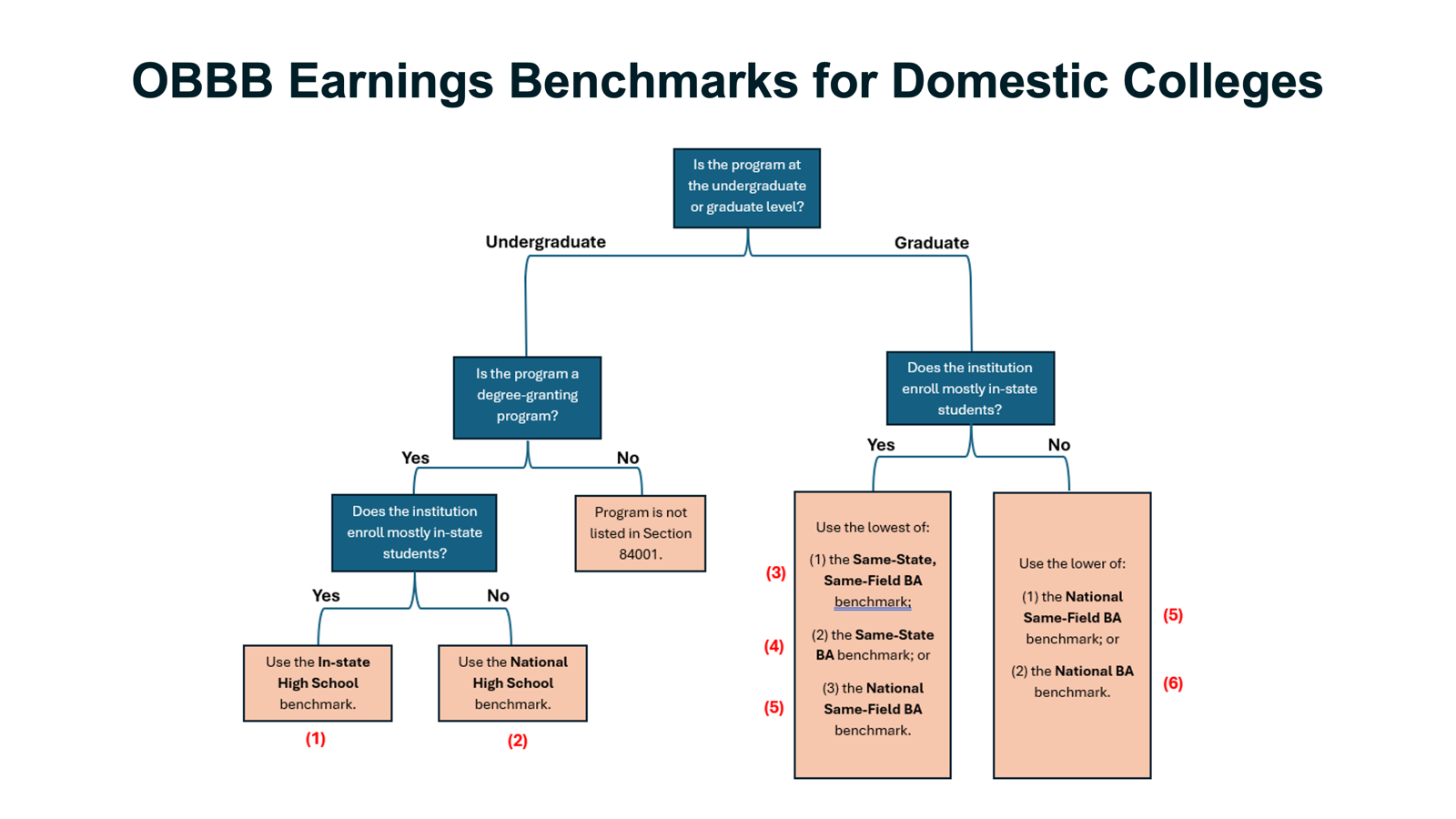
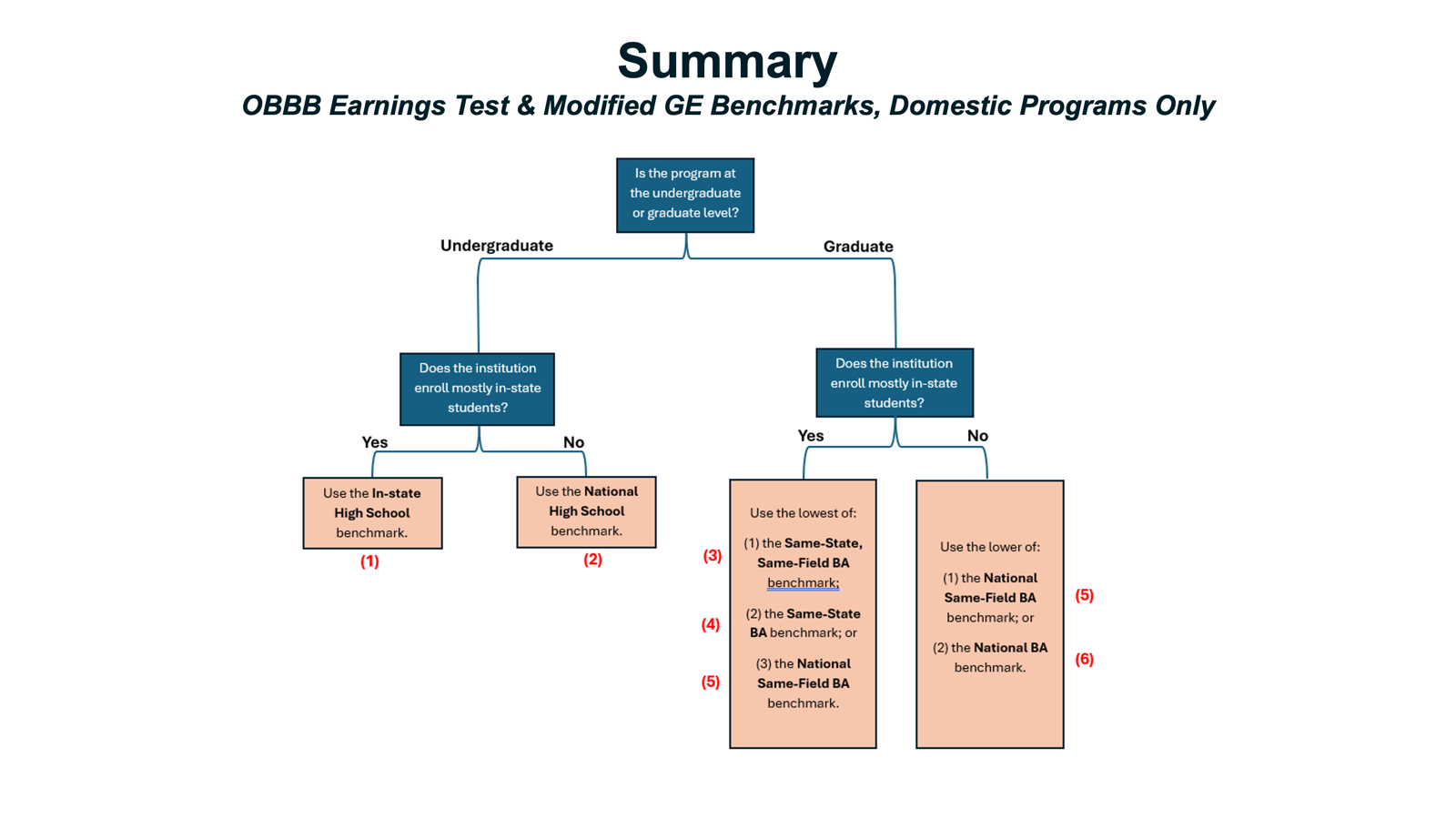
The earnings premium is a financial metric used to determine whether a program's graduates earn more than a set benchmark, known as the earnings threshold. If the median annual earnings of recent graduates exceed this threshold, the premium is positive; if they are equal, the premium is zero; and if they are lower, the premium is considered negative.
For undergraduate programs, the earnings threshold is based on the median earnings of working adults aged 25 to 34 who hold only a high school diploma (or equivalent) and are not currently enrolled in further education. This benchmark is generally calculated using data from the state in which the institution is located. However, if more than 50% of the students enrolled in the program come from outside that state, or if the institution is a foreign school, the threshold is instead based on the national median earnings for high school graduates in the United States.
The earnings threshold for graduate programs is based on the median earnings of working adults aged 25 to 34 who hold only a bachelor’s degree. To establish this benchmark, the department uses a "lowest-of" logic to ensure the comparison group is as stringent as possible. For most institutions, the threshold is the lowest value among the median state earnings for bachelor’s degree holders, the state earnings for that specific field of study, or the national earnings for that field of study. If the graduate program primarily serves out-of-state students, the threshold is the lower of the national median for all bachelor’s degree holders or the national median for that specific field of study.
Throughout the day, three presentations were led by Cody Christensen from ED’s Office of the Chief Economist.
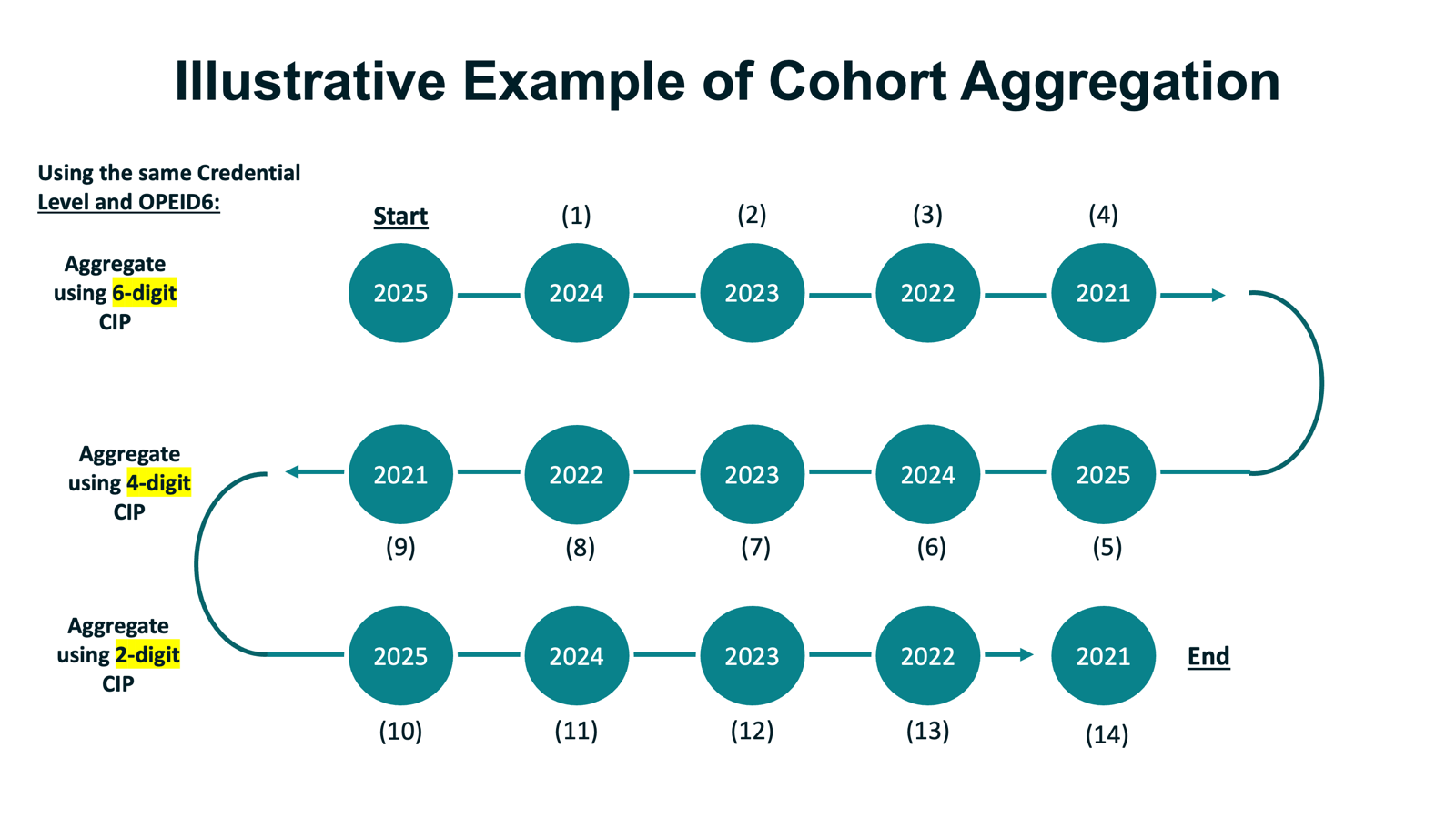
The first presentation reviewed how ED plans to identify cohorts of individuals whose earnings will be included in the earnings premium metric and what the process is for aggregating cohorts when ED needs to do so due to a small number of program completers. Christensen stated that aggregation will be required in many cases, as data show that only 9% of programs have more than 30 Title IV completers in a single award year.
The process would first identify additional completers one award year at a time in the same program (6-digit CIP Code) for four additional award years prior to the original cohort period, until 30 completers were identified. If 30 cannot be identified after including completers from the same 6-digit CIP Code program for four additional award years, the Department would repeat the process for all programs with the same 4-digit CIP Code and credential level, and then, if necessary, again for programs with the same 2-digit CIP Code and credential level. If at least 30 Title IV completers are still not able to be aggregated after following these steps, the program is exempt from the earnings premium test. Christensen explained that there may be situations where the data is deemed unreliable by the Secretary. For example, even though they reached 30 completers, the Secretary doesn't believe that number is sufficient to perform the calculation for a specific program. In these cases, the cohort size may be increased until the Secretary determines the data are statistically reliable. ED predicts that 94% of all Title IV completers are in programs that achieve a statistically reliable cohort size after implementing the full aggregation method.
The second presentation covered definitions of “earnings” and “working.” ED said it is still contemplating how it will ultimately choose to define them for the earnings calculation, as the different ways to determine them could impact the earnings accountability framework. For example, the definition of “earnings” has two options – it could be defined as “personal income from wages and salary” or “personal income from wages, salary, and income through self-employment.” Additionally, “working” could be defined as “individuals who are in the labor force,” which includes both employed and unemployed people, or it could be limited to employed people.
The third presentation focused on the estimated impact of the earnings test using currently available data. According to current estimates, approximately 6% of programs are expected to fail the earnings test. While this represents a small portion of programs, it affects about 5% of all Title IV recipient students, the majority of whom, roughly 55%, attend for-profit institutions. The impact is particularly significant for undergraduate certificate programs, where nearly one in three students (31%) are enrolled in a program that fails to meet the earnings threshold.
Certain fields of study, including Culinary Services, Cosmetology, Drama/Fine Arts, Religious Studies, and Alternative & Complementary Medicine, exhibit the highest fail rates. Additionally, the geographic impact is uneven, as states such as Florida, Louisiana, Tennessee, California, and Idaho have a much higher share of failing programs relative to other states. Related, The HEA Group, conducted its own study of the data ED made available to determine which college programs may remain eligible to participate in the federal student loan program.
Christensen clarified final data won’t be available until early 2027, and stressed that this presentation is solely an estimate.
Throughout Monday’s session, negotiators raised concerns that ED’s proposed earnings test may be overly restrictive and could inadvertently disadvantage some potentially high-quality programs, particularly those that prepare students for lower-paying but in-demand fields. Lacey pointed to data provided by ED on programs that would fail ED’s new earnings metrics, noting that 92% of cosmetology programs would fail.
“I do not believe that 92% of the programs in the United States for cosmetology lack merit,” Lacey said. “They just don't pass this test in the way that it's formulated. And I think Congress has said the consequence here is a lack of opportunity to borrow.”
Musser noted that the AHEAD Committee will meet again on Tuesday to continue discussion on its new accountability framework. Stay tuned to Today’s News for more daily coverage of this week’s negotiated rulemaking session.
Publication Date: 1/6/2026


Megan W | 1/6/2026 2:19:04 PM
Just flagging for the commenters below, "institutions will now be required to report all NEW programs (GE and non-GE) to ED via Partner Connect within 10 days of offering them". This proposal would only apply to NEW programs, not all currently existing programs. As a reminder, this is proposed language from very early in the negotiated rulemaking session, this is still subject to change.
Thomas P | 1/6/2026 12:56:30 PM
"ED centered on new reporting requirements related to program eligibility. Musser explained that all institutions will now be required to report all new programs (GE and non-GE) to ED via Partner Connect within 10 days of offering them, a shift from the current rules that only require this reporting for new GE programs."
I agree we need more clarity on this either through a Dear Colleague Letter or at the FSA Conference.
Ashly E | 1/6/2026 12:29:34 PM
Our institution is approved for DEGREE programs at associates, bachelors, masters, and doctoral level. We do not list each individual degree. Is this new proposed rule saying every single degree program (to what CIP level?) would be required to be reported?
Not fun. But I suppose, as long as we don't have to wait for ED's approval to fund, it's just another administrative burden.
Ryan W | 1/6/2026 12:17:41 PM
Adding all programs to the E-App would be a nightmare. In 24 years in financial aid, that process has never worked well, but now with way fewer staff and more work, it will be manageable? I'll give them credit for updating it to not look like you're using netscape navigator any longer, but the updated product is only marginally better than the prior version (and I think one could argue it actually isn't better at all). Count me skeptical at the capacity that ED seems to have; I'll give them sarcasm points for confidence though.
You must be logged in to comment on this page.