



Deep Dive: NASFAA Summary of Consensus on Accountability Language from Last Week’s AHEAD Negotiated Rulemaking Committee
By Jill Desjean, Director of Policy Analysis
Last Friday, the Department of Education (ED) concluded its negotiated rulemaking session to implement the new low earnings outcomes accountability metric from the One Big Beautiful Bill Act (OBBBA). The Accountability in Higher Education and Access through Demand-driven Workforce Pell (AHEAD) committee reached consensus on this new accountability framework, meaning that ED’s proposed regulatory text for public comment — expected in the first half of 2026 — will match what negotiators agreed to.
As a reminder, ED must review comments received during the public comment period and incorporate that feedback into the regulatory text before issuing a final rule. As such, this summary of the consensus language negotiators agreed to is subject to change pending publication of a final rule.
Background
The OBBBA introduced, for the first time in statute, an earnings accountability measure (Ineligibility Based on Low Earning Outcomes) to ensure that students do not leave a program of study financially worse off than when they entered it. A “do-no-harm” framework, the measure attempts to establish whether students have benefited from their postsecondary educational programs by calculating an earnings premium, calculated as the difference between a program’s graduates’ median earnings four years after completion and a set threshold.
A program whose completers’ earnings exceed or equal the threshold is considered to pass the earnings test; a program whose completers fall short of the threshold fails and is designated a “low-earning outcome program.” Failure in two of three consecutive years results in the program’s loss of eligibility to participate in the Direct Loan program for two years.
New Proposed Framework
Prior attempts to hold institutions accountable for their graduates’ earnings existed only at the regulatory level, through the Gainful Employment and, most recently, the combined Gainful Employment and Financial Value Transparency (GE/FVT) regulations. In implementing the new do-no-harm framework, ED chose to overhaul the existing GE/FVT regulations rather than simply adding the new median earnings accountability measure from the OBBBA to the existing regulations.
This approach addresses two issues. First, it acknowledges that the new earnings accountability measure from the do-no-harm framework is highly similar to the existing earnings premium metric in the GE/FVT regulations and, as such, it is not necessary to maintain both. Second, it establishes a uniform penalty for all programs, whereas the GE/FVT regulations were bifurcated, with different penalties for different program types.
The new framework eliminates the debt-to-earnings (DTE) metric and uses a single metric, the earnings premium, to determine whether a program is a low-earning outcome program. It applies a consistent penalty — loss of eligibility to participate in the Direct Loan program for 2 years after failing the earnings premium in 2 of 3 consecutive years — to all programs at all institutions.
Subpart Q of the Student Assistance General Provisions in CFR §668, formerly the Financial Value Transparency framework, is now called the Student Tuition and Transparency System (STATS) and contains the framework for calculating the earnings premium metric. Subpart S, formerly the Gainful Employment framework, is now renamed “earnings accountability,” and includes the rules and procedures under which ED determines program eligibility to participate in the Direct Loan program based on whether it is determined to be a low earning outcome program.
Earnings Premium Calculation
To calculate the earnings premium for undergraduate programs, the threshold is the median U.S. Census Bureau earnings of a working high school graduate, aged 25-34 who were not enrolled in postsecondary education during the year of the associated measured earnings, in the state in which the institution is located unless the institution enrolls more than 50% of its students from out of state, in which case the national median is used.
To calculate the earnings premium for graduate programs, the threshold is the median U.S. Census Bureau earnings of a working bachelor’s degree recipient, aged 25-34 who were not enrolled in postsecondary education during the year of the associated measured earnings. The median earnings used for graduate programs will be the lesser of the earnings:
-
In the state the institution is located;
-
In the same field of study under the 2-digit or 4-digit Classification of Instructional Programs (CIP) in the state in which the institution is located; or
-
Nationally, in the same 2-digit or 4-digit CIP.
If the institution enrolls more than 50% of students from out of state, the median earnings used would be the lower of the national median or the national median in the same field of study under the 2-digit or 4-digit CIP code.
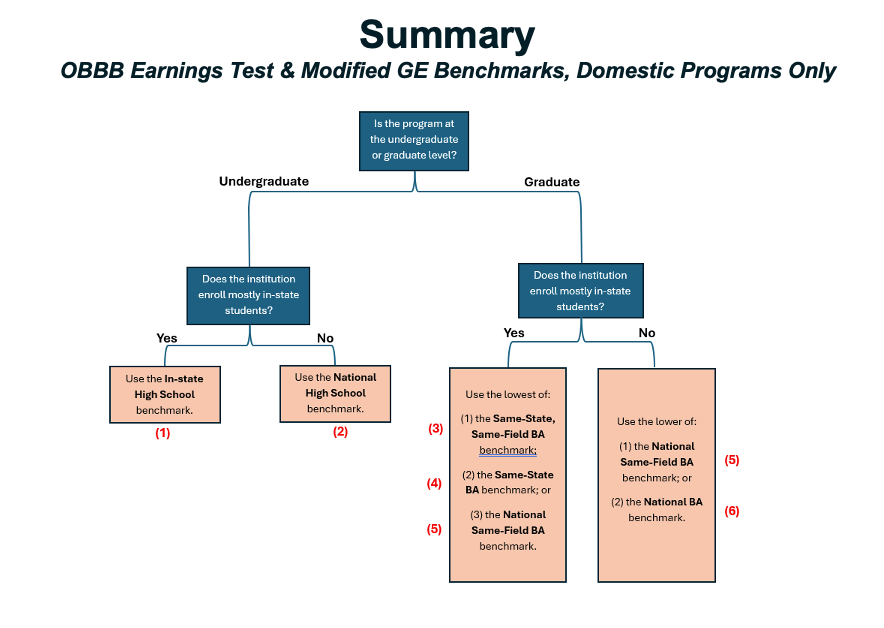
Foreign institutions will have their program completers’ median earnings calculated as shown in the figure below.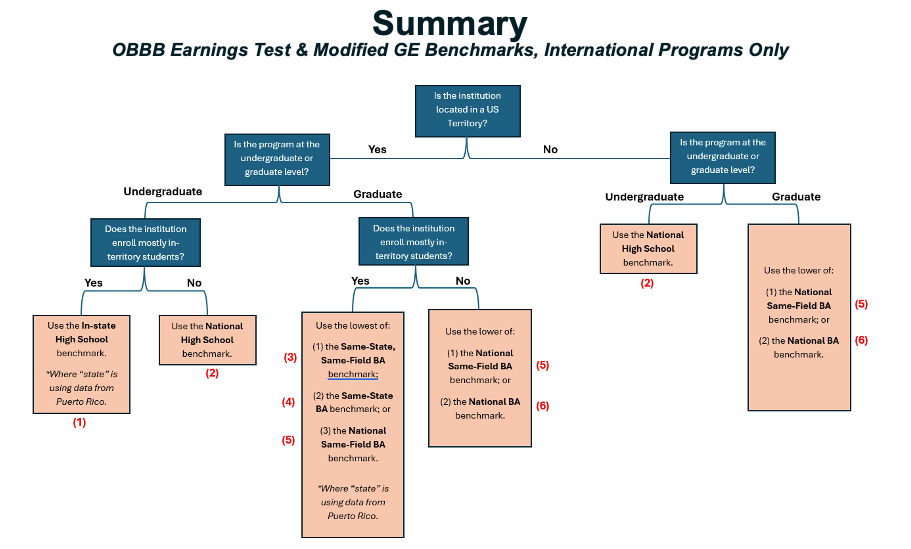
Orderly Program Closure
Programs that fail to pass the earnings premium metric in a single year would have the option to append their Program Participation Agreement (PPA), committing to cease all new enrollments in that program and teach out the existing cohort. ED would have to determine that such action would be in the best interest of students, and would permit extension of Direct Loan eligibility for a maximum of the lesser of three years or the full-time normal duration of the program. ED would continue to calculate and publish the program’s second-year accountability rate, but would not move to terminate the program’s Direct Loan eligibility based on that second failure.
Additional Penalties for Institutions With Significant Title IV Dollars or Students From Failing Programs
ED proposes to add a new administrative capability standard, requiring that at least half of the institution’s Title IV recipients and half of the institution’s total Title IV funds are not from low-earning outcome programs in any two of three consecutive years.
The PPA regulations are also amended to state that an institution that did not meet this new administrative capability standard in two of three consecutive award years would be placed on provisional certification status, and the institution’s low earning outcome programs would lose eligibility for all Title IV aid programs, not just Direct Loans.
Appeals
An appeals process is in place for the low earning outcome determination, but it is limited to circumstances where institutions believe ED erred in its calculation of the earnings premium. There is no alternate earnings appeal process as had been in place under earlier iterations of the GE regulations. Institutions may also appeal the loss of all Title IV eligibility for failing programs at institutions where more than half of their Title IV recipients or dollars come from failing programs.
Institutional Reporting
Institutional reporting requirements for the new accountability framework are largely similar to the GE/FVT reporting requirements. Reporting will continue to be due each October 1, with earnings premium data published by the following July. ED has indicated that, due to limited time to make changes, reporting will not change from what is currently required under GE/FVT for 2026; however, they will require fewer data elements to be reported in future years. Data elements to be eliminated beginning in 2027 include:
-
Whether the program is a qualifying graduate program whose students are required to complete postgraduate training;
-
The student's attendance dates and attendance status (e.g., enrolled, withdrawn, or completed) in the program during the award year;
-
The student's enrollment status (e.g., full time, three quarter time, half time, less than half time) as of the first day of the student's enrollment in the program;
-
The date the student completed or withdrew from the program;
-
The total amount of institutional debt the student owes any party after completing or withdrawing from the program.
Data must only be reported for the two most recently completed award years prior to October 1, as opposed to the second through seventh under GE/FVT.
Timelines
Congress established an effective date of July 1, 2026, for the new accountability framework. Because the OBBBA was passed on July 4, 2025, ED does not have to follow standard master calendar rules, which would have required a final rule to have been published by November 1, 2025.
The effective date of July 1, 2026, means that the first earnings premium calculations under the new rule will be released by July 1, 2027. Because programs only lose Direct Loan eligibility if they fail the metric in 2 of 3 consecutive years, the earliest a program could lose eligibility is July 1, 2028.
ED must, however, still release its proposed rules for public comment, which are expected in early 2026. ED must then review all comments, draft, and publish a final rule by June 1, 2026. Until then, everything detailed here is subject to change.
Publication Date: 1/13/2026


You must be logged in to comment on this page.