



AHEAD Committee Discusses Details on New Earnings Accountability Reporting Requirements, Appeals Process
By Maria Carrasco, NASFAA Staff Reporter , Megan Walter, Senior Policy Analyst
The Accountability in Higher Education and Access through Demand-driven Workforce Pell (AHEAD) Committee on Wednesday continued working through the proposal from the Department of Education (ED) regarding institutional reporting requirements and the appeals process, as part of the overhaul to the Gainful Employment (GE) and Financial Value Transparency (FVT) regulations to implement the new institutional accountability framework established under the One Big Beautiful Bill Act (OBBBA).
Wednesday’s session began with a discussion from negotiators, in which Ritchie Morrow, a negotiator representing state grant agencies and other state and non-profit higher education financing organizations, noted that the reporting requirements create a tight time crunch for institutions, as the deadline is July 1, 2026. Dave Musser, ED’s federal negotiator, clarified that ED will not be able to implement all these changes by fall 2026. Therefore, any reporting due this fall will be the same as the existing GE/FVT reporting requirements; fall 2027 will be the first time that the new reporting requirements discussed in these proposals will be due.
Musser added that the department does plan to offer the opportunity for institutions to implement these changes early and that ED is still working on what that means for reporting, but would assume it would mean that institutions which do plan to implement these regulations early will have the option of using the new earnings premium metric process, or the current debt-to-earnings (DTE) and earnings premium process. He noted that institutions should have already set up their reporting apparatus to comply with the current GE/FVT reporting regulations and that institutions will have to use that same process; they'd just have less to report if they choose to implement this part of the regulation early.
With questions surrounding the timeline and implementation of the earnings premium, Cody Christensen, of ED’s Office of the Chief Economist, produced another presentation for the negotiators outlining rollout logistics.
The official timeline for the program accountability framework will begin in early 2027, when the first earnings test is calculated, and institutions are notified of its results. While July 1, 2027, marks the first date a program can officially “fail” the test, the consequences for direct loan eligibility would not take effect immediately, as a program would need to fail two out of three years to lose funding.
The second earnings test would be conducted in early 2028, with results shared with institutions shortly after. The most critical milestone will be July 1, 2028, which marks the first date that programs failing to meet the premium earnings threshold for those first two years it is in place can lose access to federal student loans.
For the first premium earnings test, results of which will be made available to institutions in early 2027, ED will examine students who completed their programs during the 2021 award year. By December 2025, these graduates will have been out of college for four years, allowing for a look at their career earnings four years after graduation, as required by statute. ED will pull tax information in early 2027 based on filings from April 2026, which cover the 2025 tax calendar year, ensuring that the most recent verified tax data is used to evaluate the financial outcomes of former students.
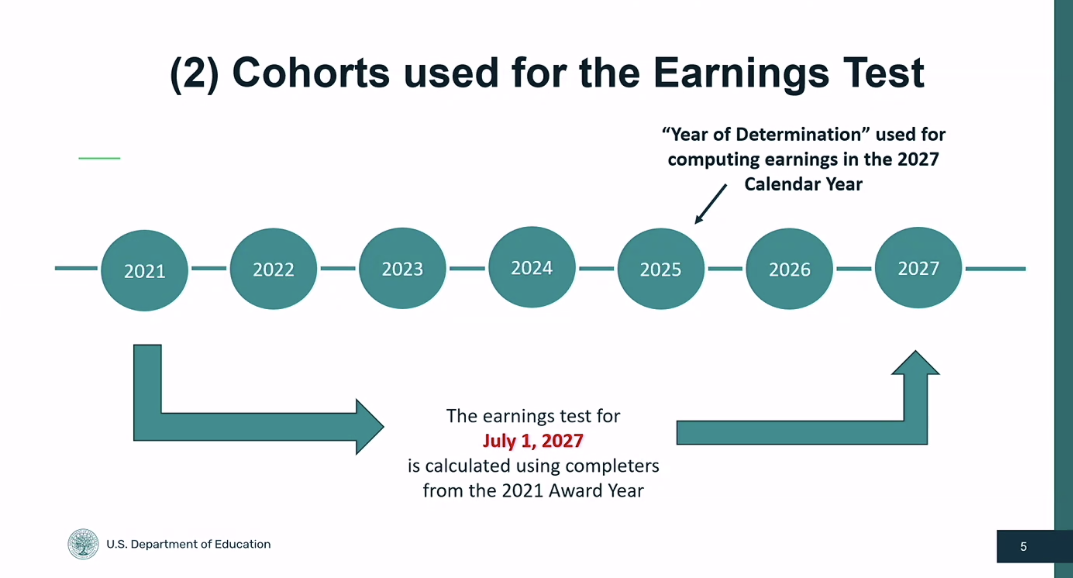
Aaron Lacey, a negotiator representing private nonprofit institutions, raised concerns about the inconsistency created by ED producing data before the accountability framework is fully in effect. He suggested treating the first data pull, expected in early 2027, as an informative/informational year rather than one that counts toward Direct Loan program eligibility. This would give schools time to identify programs that appear likely to fail and either improve them, warn currently enrolled students, or phase out the program.
Jeffrey Andrade, the deputy assistant secretary for policy, planning, and innovation at ED, proposed a potential teach-out provision that would allow students to complete their programs and maintain loan eligibility even if the program has failed the earnings premium test twice within a three-year period. While the department is still evaluating whether the OBBBA provides sufficient statutory authority for such exceptions, the intent is to create a runway that prevents students from being abruptly cut off from access to Direct Loans. Lacey said the interim exception used in the OBBBA for continuing Grad PLUS loan borrowing and borrowing under existing loan limits could serve as a model for extending Direct Loan eligibility to students in “failed” programs.
The conversation then turned to the appeal process. ED explained that in the case of a “failed” year, an institution may appeal the department’s findings. The process begins once the department notifies the school that a program has failed the earnings test, triggering a six-month window for the institution to review the underlying data used in the calculation for potential errors. During this period, the program remains eligible for federal student loans while the school examines the accuracy of the cohort data or identifies calculation mistakes. If the institution uncovers an error, it may request a correction before the failure takes effect in the following award year. If the school does not appeal or if the department rejects its claim, the program will lose eligibility on July 1 of that award year.
The timeline for resolving an appeal can vary. It may conclude quickly if the institution exhausts its remedies early, or it may extend for several months if the matter is taken before an administrative law judge. To streamline the process, the department intends to limit appeals strictly to data-related challenges. Once all administrative remedies have been exhausted, the program’s loss of eligibility becomes final, unless the institution chooses to pursue the matter in court.
ED made it clear that its proposal intends to limit appeals to only data issues. Lacey spoke up again to call attention to a proposal he submitted, which would allow an institution to appeal based on the use of local earnings data. This would allow institutions in rural or low-income areas to challenge a failing "earnings premium" determination by using local labor market data instead of statewide averages. Lacey argued that because wages vary significantly within states, programs in small towns are unfairly penalized when measured against high-earning urban centers. There was support among a few of the negotiators, and ED said they would discuss it privately after conversations around the subject had settled.
In the afternoon, the AHEAD Committee returned to the conversation around the teach-out proposals. During the break, a handful of negotiators met and developed a new proposal for ED to consider. Lacey proposed creating a voluntary teach-out agreement option for institutions whose program fails the accountability test once. Under this approach, after receiving the first failing determination, an institution could opt into an addendum to its PPA committing to stop enrolling all new students — not just Title IV students — and teach out the existing cohort. ED would still calculate and publish the program’s second-year rate, but would not proceed to initiate any program termination.
Once the program fully completes its teach-out, it would still face the standard two-year period of ineligibility, including restrictions on offering any substantially similar program. The goal, Lacey explained, is to protect students, prevent institutions from “gaming” the system, and provide schools with a structured path to wind down programs that cannot function without Title IV aid. Institutions could choose not to opt in to the teach-out option if they believe they can pass the second-year rate or operate without Title IV funds.
“[The institution] can enter into this contractual relationship with the department subject to all these conditions, but that would allow them to actually complete the program,” Lacey said. “It protects students. It incentivizes institutions, and it puts programs on a trajectory sooner than they otherwise would have, if [their program] failed two years in a row.”
Andrade and Musser both thanked Lacey for the proposal, and Musser confirmed that ED would look at Lacey’s written proposal.
Musser reviewed ED’s final section of proposed regulations, student warnings, which includes the criteria that trigger a warning requirement and what that warning would entail.
He clarified that these warnings would apply to currently enrolled students and prospective students.
Per the proposed regulations, these warnings must explicitly state that the program failed to meet earnings benchmarks and could lose Direct Loan funding, while also providing a link to the department’s official program information website. For currently enrolled students, the institution must deliver this warning as a standalone communication within 30 days of a failure notice.
For prospective students, the regulation requires that the warning be delivered at the very first point of contact, whether in person, via email, or over the phone. Institutions are strictly prohibited from enrolling, registering, or accepting financial commitments from prospective students until at least three business days after the warning has been delivered. Furthermore, no federal student aid funds can be disbursed, and no enrollment agreements can be finalized, until the student acknowledges having viewed the warning.
Finally, the regulation specifies that providing these warnings does not relieve the institution of its obligation to provide accurate information, nor does a student's acknowledgment of the warning automatically disqualify them from future loan discharge claims.
Musser added that ED will provide a “guiding document” for institutions to create their student warning through the Federal Register.
The AHEAD Committee will reconvene on Thursday to continue its discussions. Stay tuned to Today’s News for more daily coverage of this week’s negotiated rulemaking session.
Publication Date: 1/8/2026


You must be logged in to comment on this page.