



Working Paper Examines Impact of Free Community College in Tennessee
By Maria Carrasco, NASFAA Staff Reporter
A working paper examining the results of Tennessee Promise, a community college scholarship program, found strong evidence that the program increased college enrollment among new high school graduates and raised associate’s degree attainment at minimal cost to the state.
The working paper, conducted by researchers at Saint Mary's College of California, the University of Tennessee, Knoxville, and the Tennessee government, examined how the introduction of Tennessee Promise in 2015 impacted college enrollment using IPEDS data from 2000- 2023 and American Community Survey data from 2000-2024.
Tennessee Promise is a program that provides students a last-dollar scholarship, meaning the scholarship will cover the cost of tuition and mandatory fees not covered by gift aid. The scholarship can be used at any of the state’s 13 community colleges, 22 colleges of applied technology, or other eligible institutions offering an associate degree program.
The researchers found that since the start of the program, college enrollment among traditional-age high school graduates grew by 5.4%.
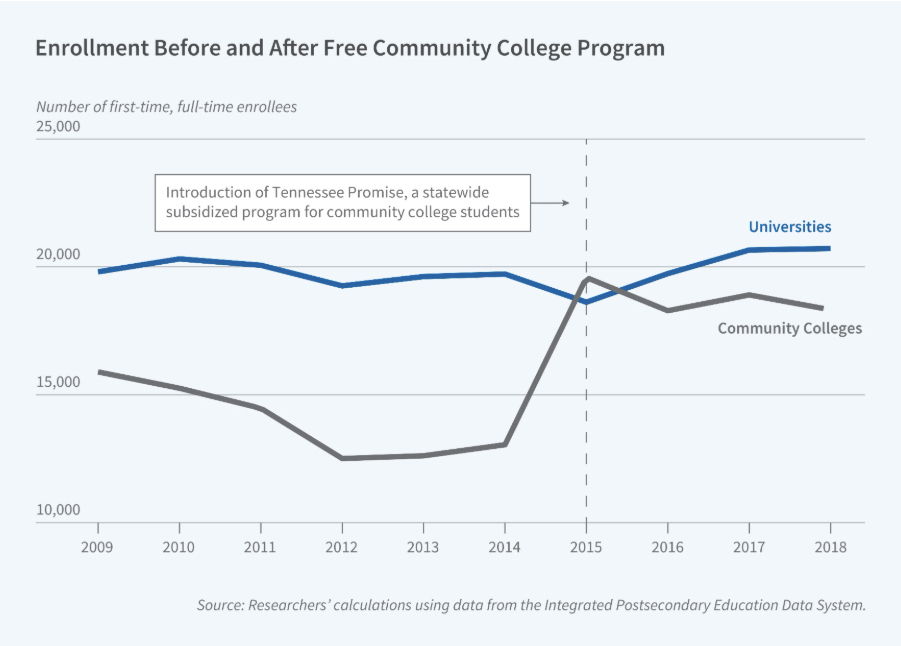
Beyond enrollment, researchers found that the program also accounted for a 15% increase in associate degree attainment at Tennessee community colleges. Even more, the researchers found that many of these students are then enrolling into bachelor’s degree programs, finding a 24% increase in the number of students who transferred to bachelor’s programs.
The researchers wrote that they estimated that Tennessee Promise delivered benefits that likely exceeded its public costs – which is under $1,000 per year per student.
“Even under conservative assumptions, the marginal value of public funds compares favorably to other postsecondary aid programs, many of which provide more funding per student to a narrower base of eligible individuals,” the paper reads. “Taken together, the results indicate that a simple, last-dollar tuition guarantee tied to community colleges can expand access and increase two-year degree completion without evidence of harm to four-year attainment, and with marginally significant evidence of gains in bachelor’s degree completion, even when implemented at scale.”
The paper did note limitations of the study, indicating that further research is needed as different states implement free tuition programs.
“Although many state Promise programs resemble Tennessee’s last-dollar, community-college-focused design, they differ in eligibility rules, funding structure, post-college requirements, and the consistency of these aspects from one year to the next,” the working paper reads. “Understanding how these design features shape student outcomes remains an important question as free college proposals continue to evolve.”
Publication Date: 10/5/2026



You must be logged in to comment on this page.