


2026 STATS/Earnings Accountability
Overview
On July 25, 2025, the Department of Education (ED) announced its intent to establish the Accountability in Higher Education and Access through Demand-driven Workforce Pell (AHEAD) negotiated rulemaking committee to, among other things, implement the new low earnings outcomes accountability metric from the One Big Beautiful Bill Act (OBBBA). Public hearings were held on August 7, 2025, and negotiations were held in person over two weeks in December 2025 and January 2026. Negotiators reached consensus on this new accountability framework, with proposed rules released on April 20, 2026 and final rules issued on July 1, 2026, with most provisions effective July 1, 2027. Institutions were offered the opportunity to choose an early implementation date of July 1, 2026.
The OBBBA introduced, for the first time in statute, an earnings accountability measure (Ineligibility Based on Low Earning Outcomes) to ensure that students do not leave a program of study financially worse off than when they entered it. A “do-no-harm” framework, the measure attempts to establish whether students have benefited from their postsecondary educational programs by calculating an earnings premium, calculated as the difference between a program’s graduates’ median earnings four years after completion and a set threshold.
A program whose completers’ earnings exceed or equal the threshold is considered to pass the earnings test; a program whose completers fall short of the threshold fails and is designated a “low-earning outcome program”. Failure in two of three consecutive years results in the program’s loss of eligibility to participate in the Direct Loan program for two years.
STATS/Earnings Accountability Framework
Prior attempts to hold institutions accountable for their graduates’ earnings existed only at the regulatory level, through the Gainful Employment and, most recently, the combined Gainful Employment and Financial Value Transparency (GE/FVT) regulations. In implementing the STATS/earnings accountability framework, the Department of Education (ED) chose to swap out the previous GE/FVT regulations with the new rules established in the OBBBA.
This approach addresses two issues. First, it acknowledges that the new earnings accountability measure from the do-no-harm framework is highly similar to the earnings premium metric in the 2023 GE/FVT regulations and, as such, it is not necessary to maintain both. Second, it establishes a uniform penalty for all programs, whereas the GE/FVT regulations were bifurcated, with different penalties for different program types.
The eligibility consequences of the regulations do not apply to institutions that enroll only students with a documented specific learning disability or autism. Eligibility consequences apply to, but are delayed for, programs that prepare students for occupations in which a majority of workers earn tipped income. Such programs will be treated neither as passing nor as failing the earnings premium for any year in which graduates’ earnings are measured in 2025 or earlier, prior to when the OBBBA’s “no tax on tips” provision applies.
The framework eliminates the debt-to-earnings (DTE) metric and uses a single metric, the earnings premium, to determine whether a program is a “low-earning outcome program.” It applies a consistent penalty— loss of eligibility to participate in the Direct Loan program for 2 years after failing the earnings premium in 2 of 3 consecutive years—to all programs at all institutions.
Subpart Q of the Student Assistance General Provisions in CFR §668, formerly the Financial Value Transparency framework, is now called the Student Tuition and Transparency System (STATS) and contains the framework for calculating the earnings premium metric. Subpart S, formerly the Gainful Employment framework, was renamed “earnings accountability,” and includes the rules and procedures under which ED determines program eligibility to participate in the Direct Loan program based on whether it is determined to be a low earning outcome program.
Earnings Premium Calculation
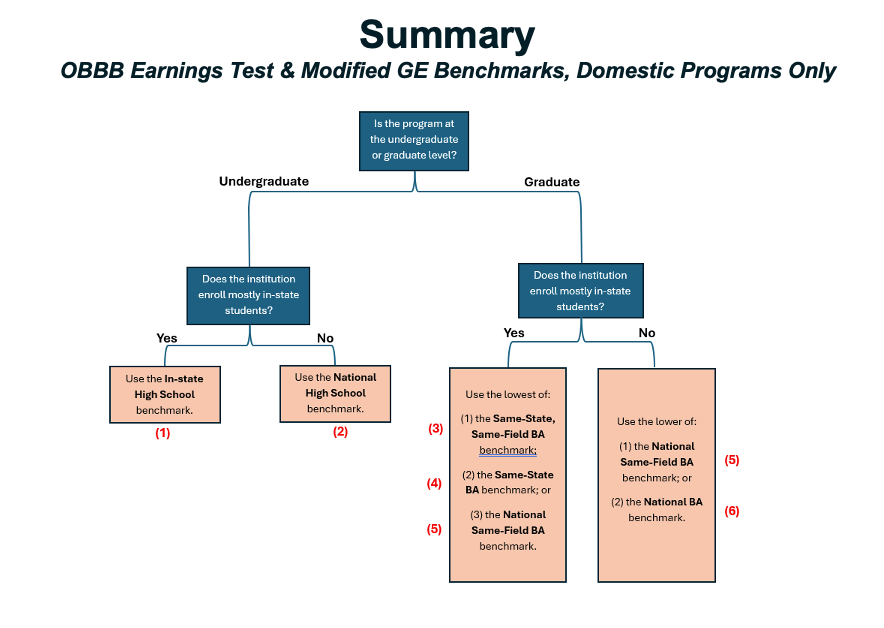
To calculate the earnings premium for undergraduate programs, the threshold is the median U.S. Census Bureau earnings of a working high school graduate, aged 25-34 who were not enrolled in postsecondary education during the year of the associated measured earnings, in the state in which the institution is located unless the institution enrolls more than 50% of its students from out of state, in which case the national median is used.
To calculate the earnings premium for graduate programs, the threshold is the median U.S. Census Bureau earnings of a working bachelor’s degree recipient, aged 25-34 who were not enrolled in postsecondary education during the year of the associated measured earnings. The median earnings used for graduate programs will be the lesser of the earnings:
- In the state the institution is located;
- In the same field of study under the 2-digit or 4-digit Classification of Instructional Programs (CIP) in the state in which the institution is located (This threshold will be set to $1 for states where the Census Bureau data necessary to perform the calculations are not available); or
- Nationally, in the same 2-digit or 4-digit CIP.
If the institution enrolls more than 50% of students from out of state, the median earnings figure is the lower of the national median or the national median in the same field of study under the 2-digit or 4-digit CIP code.
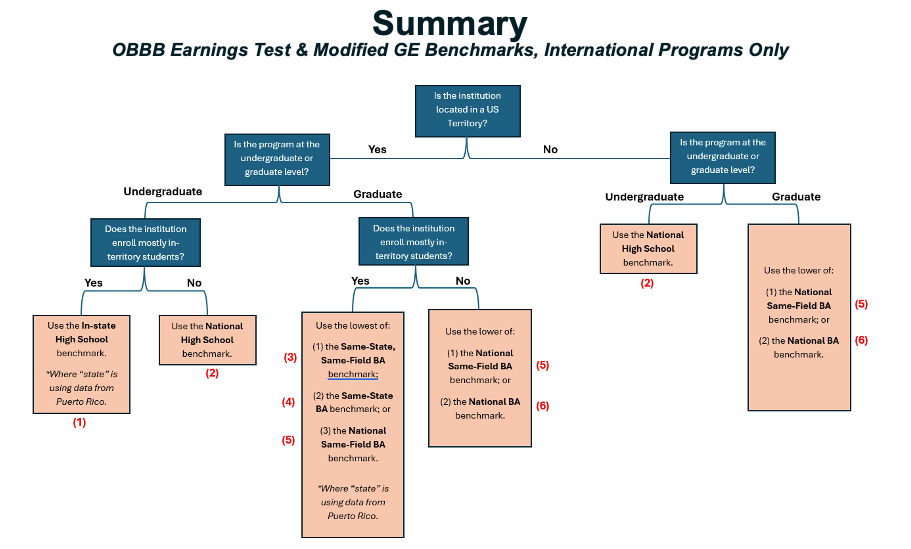
Foreign institutions will have their program completers’ median earnings calculated as shown in the figure below.
Cohorts
The standard cohort for calculating the earnings premium metric is all program completers in the same 6-digit Classification of Instructional Programs (CIP) code for the fourth award year prior to the year for which the most recent earnings data are available from the Federal agency when the earnings premium measure is calculated. When the number of students in that cohort is less than 30, ED expands the cohort. They first look back as far as the seventh award year prior to when the most recent earnings data are available, at the same 6-digit CIP code level. If that expanded cohort size is still smaller than 30, ED will further expand to the 4-digit CIP code level, again looking back as far as the seventh award year prior to when the most recent earnings data are available.
Orderly Program Closure
Programs that fail the earnings premium metric in a single year have the option to append their Program Participation Agreement (PPA), committing to cease all new enrollments in that program and teach out the existing students enrolled in the program. ED would have to determine that such action would be in the best interest of students, and would permit extension of Direct Loan eligibility for a maximum of the lesser of three years or the full-time normal duration of the program. ED would continue to calculate and publish the program’s second-year accountability rate, but would not move to terminate the program’s Direct Loan eligibility based on that second failure.
Additional Penalties for Institutions With Significant Title IV Dollars or Students From Failing Programs
The 2026 regulations also added a new administrative capability standard, requiring that at least half of the institution’s Title IV recipients and half of the institution’s total Title IV funds are not from low-earning outcome programs in any two of three consecutive years.
The PPA regulations were also amended to state that an institution that did not meet this new administrative capability standard in two of three consecutive award years will be placed on provisional certification status, and the institution’s low-earning outcome programs will lose eligibility for all Title IV aid programs, not just Direct Loans.
Programs offered by institutions that do not participate in the Direct Loan program, and have not participated in the five most recently completed award years prior to the year in which the earnings premium measure is calculated are exempt from potential loss of all TITIV aid. The same exemption also applies to institutions that agree not to permit Direct Loan borrowing for a failing program for at least five consecutive award years, provided ED determines that doing so is in the best interests of students.
Warnings to Students
Institutions are required to provide warnings to current and prospective students enrolled in programs that fail the earnings accountability metric in any year that the program could lose Direct Loan or all Title IV eligibility.
Appeals
An appeals process is in place for the low-earning outcome determination, but it is limited to circumstances where institutions believe ED erred in its calculation of the earnings premium, such as using an inaccurate completers list, incorrect calculation of the earnings threshold, or errors in the comparison of median completers earnings against the earnings threshold. There is no alternate earnings appeal process as had been in place under earlier iterations of the GE regulations. Institutions may also appeal the loss of all Title IV eligibility for failing programs where more than half of their Title IV recipients or dollars come from failing programs. Appeals will only be considered if they are submitted within 30 days of receipt of a notification of determination indicating that a program is a low-earning outcome program.
Institutional Reporting
Institutional reporting requirements for the accountability framework are largely similar to the GE/FVT reporting requirements. Reporting continues to be due each October 1, with earnings premium data published by the following July. The 2026 rules remove several data elements from what was required to be reported under the 2023 rule. ED will assume institutions have opted for early implementation of the final rules if their October 1, 2026 reporting omits the new data elements that are no longer required; no other action is required by institutions to indicate early implementation. The data elements that are no longer required are:
- Whether the program is a qualifying graduate program whose students are required to complete postgraduate training;
- The student's attendance dates and attendance status (e.g., enrolled, withdrawn, or completed) in the program during the award year;
- The student's enrollment status (e.g., full time, three quarter time, half time, less than half time) as of the first day of the student's enrollment in the program;
- The date the student completed or withdrew from the program;
- The total amount of institutional debt the student owes any party after completing or withdrawing from the program.
Data must only be reported for the two most recently completed award years prior to October 1, as opposed to the second through seventh under GE/FVT.
Timelines
Most provisions are effective July 1, 2027. Two provisions became effective August 30, 2026: the addition of definitions for “Eligible non-GE program” and “Gainful employment Program (GE program)” at CFR 685.102 and changes to CFR 685.300 whereby institutions, by nature of entering into a program participation agreement (PPA) with ED, agree that programs must meet the STATS and earnings accountability requirements in order to participate in the Direct Loan program.
The first earnings premium calculations under the new rule will be released by July 1, 2027. Because programs only lose Direct Loan eligibility if they fail the metric in 2 of 3 consecutive years, the earliest a program could lose eligibility is July 1, 2028.
NASFAA Resources
Publication Date: 9/9/2026